
Where Africa’s Clean Energy Targets Actually Stand and Why Nigeria Is the Test That Matters
The promises are bold. The delivery is not keeping pace.
Africa has set some of the most ambitious clean energy targets on the planet. Governments have signed commitments, submitted climate plans, and stood at podiums at COP summits pledging a green future. But when you look at the data behind the declarations, a significant gap opens up between what has been promised and what is actually being built.
Nigeria sits at the centre of that gap, and at the centre of its solution.
The Continental Picture
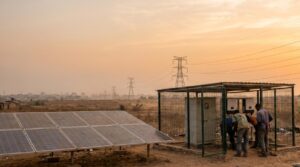
The African Union has committed to bringing 300 gigawatts (GW) of renewable energy online by 2030. Africa currently has around 72 GW. To close that gap, the continent needs to deploy roughly 32.5 GW of new renewable capacity every single year. Currently, it is deploying around 8 GW per year.
Current forecasts suggest Africa will fall 43% short of its own target. Between 2020 and 2025, Africa attracted an estimated $34 billion in clean energy investment, less than 2% of global renewable investment, despite being home to 20% of the world’s population.
No country shapes that continental picture more than Nigeria.
Why Nigeria Is a Test That Matters
Nigeria is Africa’s largest economy and most populous nation, with over 220 million people. What happens here sets the tempo for West Africa and increasingly for the continent.
Nigeria submitted its NDC 3.0 in September 2025, committing to net zero by 2060 and a reduction of 168 million tonnes of greenhouse gases by 2030. In January 2026, President Tinubu announced a $2 billion National Climate Change Fund. The ambition is real. So are the obstacles.
90 million Nigerians still lack reliable electricity access. The fastest route to connect them is gas to power. International climate financiers frequently demand a renewables only pathway as a condition of funding. Nigeria is being asked to choose between its people’s immediate needs and the conditions attached to the money available to meet them. How Nigeria resolves that tension will matter well beyond its own borders.
What Is at Stake: Economic, Environmental and Social
Economically, the cost of inaction is already visible. Erratic power supply drains productivity at every level of the economy. Businesses using hybrid renewable systems have cut operating costs by 40 to 65%. Scaling solar mini-grids could save households and companies $4.4 billion annually. Nigeria’s Energy Transition Plan projects a net positive return, with $686 billion in fuel savings against $500 billion in investment through to 2060, and over one million jobs created by 2030. Nigeria’s market size also gives it genuine negotiating leverage. Between January and October 2025, bilateral trade with China exceeded $22.3 billion, a 30% year on year increase. A zero-tariff agreement with China came into effect in May 2026, and a memorandum of understanding with South Korea to establish Africa’s first large-scale electric vehicle manufacturing plant, with capacity to produce up to 300,000 vehicles annually, signals the scale of industrial opportunity available to a country willing to use its position strategically.
Environmentally, under current policies Nigeria’s emissions are projected to reach 62 to 72% above 2010 levels by 2030. A full clean energy transition could eliminate 267 million tonnes of CO₂ equivalent per year by 2050, while reducing the gas flaring, oil spills, and diesel pollution that already burden Nigerian communities and ecosystems. Africa contributes only 3 to 4% of global greenhouse gas emissions, yet the continent is among the most exposed to climate impacts. Under 2°C of warming, crop yields across sub-Saharan Africa are projected to fall by 10%. Beyond 2°C, the fall reaches 20%. Every year of delayed transition is a year of compounding environmental exposure for the communities least equipped to absorb it.
Socially, the stakes are most immediate and most human. 90 million people without reliable electricity means children studying by candlelight, clinics without refrigeration, and women led businesses unable to operate after dark. The environmental conditions created by fossil fuel dependence compound this directly. Diesel generators, biomass cooking fuels, and Niger Delta gas flaring produce chronic air pollution and contaminated water that fall heaviest on low-income communities, women, and children. A clean energy transition could save an estimated 281,785 lives per year by 2050 through reduced air pollution alone. As climate change intensifies, Nigerian smallholder farmers face declining yields, and coastal communities in Lagos and the Niger Delta face rising sea levels and more frequent flooding. These impacts do not fall evenly. They fall on those who contributed least to the problem and have the least capacity to adapt.
What Needs to Happen
This is where the conversation must shift from diagnosis to delivery, because the evidence is clear and the window for action is narrowing.
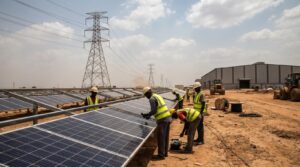
Nigeria needs integrated climate and development planning as its most urgent structural reform. NDC commitments must be embedded into national budgets and infrastructure decisions, not treated as a separate international obligation written for foreign audiences. The current reality, where over 15 climate-related policy frameworks operate in silos, is not a foundation on which serious delivery can be built.
On financing, Nigeria must stop waiting for conditions designed for countries that already have universal electricity access. The African Development Bank, the African Development Fund’s Climate Action Window, and Africa’s own pension funds, which hold approximately $400 billion in capital, represent the architecture of an African-led financing model. Nigeria should be at the forefront of building and using it, rather than depending on Western institutions whose fiscal priorities are visibly shifting toward defence and domestic spending.
Nigeria’s market size and resource wealth must also be converted into genuine industrial leverage. The zero-tariff agreement with China and the South Korea EV manufacturing partnership are promising starts, but they are the beginning of a negotiating position, not the end of one. Raw material export agreements should carry explicit conditions for technology transfer, local assembly, and preferential pricing on finished clean energy products. Indonesia’s nickel export ban demonstrates what is possible when a resource rich country decides to use its commodities as leverage rather than simply selling them.
Regional cooperation within ECOWAS offers a further dimension that Nigeria has not yet fully exploited. The West African Power Pool provides a mechanism for cross-border electricity trade. Nearly 43% of West Africa’s population lacks electricity access, meaning a coordinated regional approach could pool resources, attract larger investment packages, and prevent the race to the bottom dynamic where countries compete against each other for the same capital.
Finally, governance must match ambition. The Nigeria Energy Transition Office has mobilised over $3.6 billion in investment since 2022, which is a meaningful start. But harmonising policy frameworks, strengthening the regulatory environment, and building the monitoring systems that give investors confidence are not optional extras. They are the preconditions for scale.
Nigeria has the economic weight, the resource base, the demographic scale, and the regional influence to lead Africa’s clean energy transition. The data makes the case. The social need makes it urgent. What remains is the political will to treat this not as an international obligation but as a national project, built for Nigerians, funded intelligently, and delivered at the speed the moment demands.
References
Clean Air Task Force (2025) Aligning Africa’s Climate Ambition with Development Realities. Boston: Clean Air Task Force. Available at: catf.us (Accessed: 20 April 2026).
International Energy Agency (2024) Financing Clean Energy in Africa: World Energy Outlook Special Report. Paris: IEA. Available at: iea.org (Accessed: 20 April 2026).
International Renewable Energy Agency (2025) Tracking SDG 7: The Energy Progress Report 2025. Abu Dhabi: IRENA. Available at: irena.org (Accessed: 20 April 2026).
International Renewable Energy Agency (no date) West Africa Clean Energy Corridor. Abu Dhabi: IRENA. Available at: irena.org (Accessed: 20 April 2026).
Institute for Security Studies (2025) Energy Futures: Africa Energy Forecast. Pretoria: ISS Africa. Available at: futures.issafrica.org (Accessed: 20 April 2026).
Government of Nigeria (2025) Nigeria’s Third Nationally Determined Contribution (NDC 3.0). Abuja: Federal Government of Nigeria. Available at: unfccc.int (Accessed: 20 April 2026).
Oxford Institute for Energy Studies (2025) Africa’s Energy Transition and the Global Shift. Oxford: OIES. Available at: oxfordenergy.org (Accessed: 20 April 2026).
UNFCCC (2025) 2025 NDC Synthesis Report. Bonn: United Nations Framework Convention on Climate Change. Available at: unfccc.int (Accessed: 20 April 2026).
World Bank (2023) Nigeria DARES Project Documentation. Washington D.C.: World Bank Group. Available at: worldbank.org (Accessed: 20 April 2026).